

Stadium attendance record milestones are often the most tangible proof of a sport’s cultural dominance and the deep-seated passion of its supporters. When we talk about these numbers, we are not just discussing statistics on a spreadsheet; we are reliving the moments when the air was thick with the scent of grass and the collective breath of a hundred thousand people. These records represent the zenith of the spectator experience, where the boundary between the athlete and the fan blurs into a single, vibrating entity.
Throughout history, the quest to house as many fans as possible has driven architectural innovation and defined the legacy of legendary cities. From the dusty terraces of early 20th-century Europe to the gleaming, high-tech bowls of the modern era, the capacity of a stadium has always been a point of immense pride. For a club or a nation, holding a record is a badge of honor that speaks to the loyalty and size of their following.
However, the story of the attendance record is also one of caution and evolution. As the game grew in popularity, the sheer volume of people occasionally pushed the limits of safety, leading to a fundamental shift in how stadiums are built and managed. Today, we look back at some of the most staggering figures in sports history with a mixture of awe and disbelief, wondering how so many people could fit into a single space.
To truly understand these milestones, we must travel back to the eras where standing room was the norm and the “gate” was the only metric that mattered. It was a time of raw energy, where the roar of the crowd could be heard miles away and the physical presence of a massive audience could genuinely intimidate even the most seasoned opponents. This is the story of how football became the world’s greatest spectacle, one record-breaking crowd at a time.
The Historic Evolution of the Stadium attendance record
The most famous entry in the history books belongs to the 1950 World Cup final at the Maracanã in Rio de Janeiro. While the official figure for the match between Brazil and Uruguay is often cited around 173,850, many eye-witnesses and historians believe the actual number exceeded 200,000. Imagine the scene: a sea of white and blue shirts, a nation convinced of victory, and a stadium that was essentially a concrete cauldron of hope and nervous energy.
That day in Brazil remains the gold standard for what a crowd can be, even though it ended in one of the most famous upsets in sporting history. The “Maracanazo” proved that while a record crowd can provide an incredible advantage, it also carries a psychological weight that can crush the home team if things go wrong. The silence that fell over those 200,000 people when Uruguay scored the winning goal is said to be the loudest silence in the history of the sport.
Europe has its own legendary tallies, particularly in Scotland. Hampden Park in Glasgow holds several records that seem almost impossible by today’s standards. In 1937, a massive 149,415 people squeezed in to watch Scotland play England. This remains the highest official attendance for a football match in Europe. The passion of the British fans during this era was such that the demand for tickets far outstripped the physical capacity of the grounds, leading to the creation of those famous massive terraces.
These early records were set in an era before “all-seater” stadiums became the mandatory requirement for top-level football. Fans would stand shoulder-to-shoulder on steep concrete steps, often with very little room to move. This created an atmosphere that was incredibly intense but also presented logistical challenges that modern organizers would find terrifying. The sheer density of humanity in those classic venues is a phenomenon we are unlikely to see again in the developed world.
Safety Transformations and the Modern Stadium attendance record
The shift from standing terraces to all-seater stadiums was a turning point that changed the nature of the stadium attendance record forever. Following several tragic incidents in the 1980s, most notably the Hillsborough disaster, the Taylor Report in the United Kingdom mandated that major stadiums become all-seated. This led to a dramatic drop in total capacities but a significant increase in safety, comfort, and the overall quality of the fan experience.
While the raw numbers might have decreased in some of the older grounds, the commercial and cultural impact of the attendance record did not fade. Instead, clubs began to focus on building larger, more sophisticated all-seater arenas. The “new” Wembley Stadium, the expanded Camp Nou, and the futuristic Santiago Bernabéu are examples of how modern engineering can still accommodate nearly 100,000 people while adhering to the strictest safety protocols in the world.
Barcelona’s Camp Nou has long been the standard-bearer for European club football capacity. For decades, it has regularly hosted crowds of over 90,000 for “El Clásico” or crucial Champions League nights. There is something profoundly moving about seeing the mosaic of colors created by nearly 100,000 fans holding up cards in unison. It is a visual representation of the club’s “Més que un club” (More than a club) philosophy, showing that the fans are the foundation of everything they achieve.
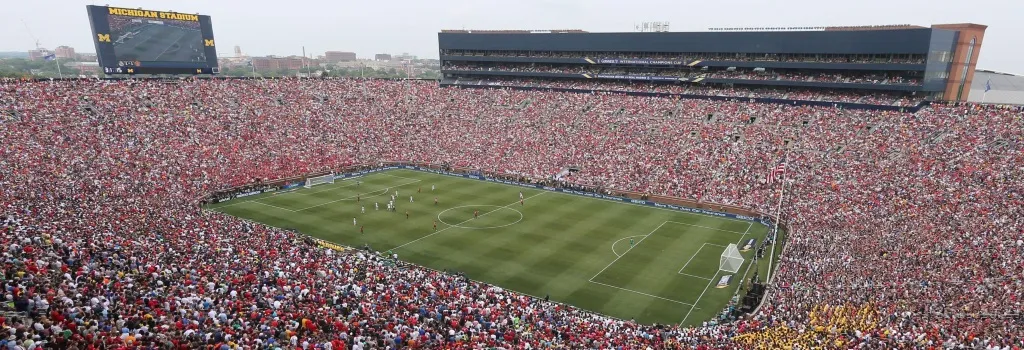
In the United States, we have seen a different kind of growth. While American football stadiums like Michigan Stadium (The Big House) have long held over 100,000 people, the rise of soccer has begun to challenge those figures. When Manchester United played Real Madrid in a friendly at Michigan Stadium in 2014, they set a U.S. record for a soccer match with 109,318 fans. This event proved that the appetite for the global game in North America was far greater than many had previously assumed.
The surge in popularity of the women’s game has provided some of the most inspiring recent entries into the stadium attendance record books. In 2022, Barcelona Women played in front of 91,648 fans at the Camp Nou during a Champions League match against Wolfsburg. This wasn’t just a record for women’s football; it was a statement of intent. It showed that the demand for the sport is universal and that when provided with a world-class platform, female athletes can draw crowds that rival any men’s match in history.
This growth in the women’s game is a testament to years of grassroots work and increasing professionalization. Seeing a packed stadium for a women’s match is a powerful image that inspires young girls around the world. It proves that the “spectacle” of a massive crowd is not exclusive to one gender or one type of tournament. As more clubs open their main stadiums for women’s fixtures, we can expect these records to be shattered repeatedly in the coming years.
Asia also boasts some of the world’s most massive venues, though they are often shrouded in a bit of mystery. The Rungrado 1st of May Stadium in Pyongyang, North Korea, is officially the largest stadium in the world, with a reported capacity of 114,000 to 150,000. While it is primarily used for the Arirang Mass Games, it also hosts national team football matches. The scale of such a venue is difficult to comprehend, representing a different approach to the stadium attendance record that is often tied to national prestige.
In India, the Salt Lake Stadium in Kolkata was once capable of holding 120,000 fans. The local derby between Mohun Bagan and East Bengal is one of the most fiercely contested in the world, and the atmosphere in a packed Salt Lake Stadium is legendary for its noise and color. While renovations for the FIFA U-17 World Cup reduced the official capacity to around 66,000 for safety and comfort, the history of those massive six-figure crowds remains a vital part of Indian footballing lore.
The psychology of being part of a record-breaking crowd is something that fans cherish for a lifetime. There is a specific kind of “stadium buzz” that occurs when every seat is filled. The collective groan when a chance is missed or the deafening roar when a goal is scored creates a physical sensation that stays with you. For the players, the “12th man” effect is very real; the energy of a massive crowd can provide the adrenaline needed to score a last-minute winner or make a goal-saving tackle.
Modern clubs now use sophisticated digital systems to track their stadium attendance record data with pinpoint accuracy. Gone are the days of manual turnstiles and rough estimates. Today, every ticket scan is recorded in real-time, allowing teams to optimize everything from security staffing to pie and beer sales. This data-driven approach has made the stadium experience more efficient, though some purists still miss the chaotic charm of the old-school gates.
However, the “official” attendance can sometimes be a point of contention. Clubs often report the number of tickets sold rather than the number of people actually in the stadium. This leads to the phenomenon of a “record crowd” being announced even when there are visible patches of empty seats. For the fans who are actually there, the true record is the one they can feel—the density of the crowd and the volume of the chants.
Infrastructure plays a massive role in a city’s ability to host these huge numbers. When a stadium expands to hold 80,000 or 90,000 people, the local transport network must be able to move that many people in a short window of time. The success of a record-breaking match often depends as much on the local bus and train drivers as it does on the strikers on the pitch. It is a massive logistical dance that requires months of planning and coordination between the club and local government.
Looking toward the future, the trend in stadium design seems to be focusing on “flexibility” rather than just raw capacity. Many new venues are being built with the ability to scale their seating up or down depending on the event. This allows a stadium to host a record-breaking crowd for a major final while maintaining an intimate atmosphere for regular league matches. Sustainability is also becoming a key factor, with stadiums using solar power and rainwater harvesting to reduce the environmental footprint of these massive gatherings.
The rise of “fan zones” and digital engagement also means that the impact of a match can extend far beyond the stadium walls. While only 80,000 people might be inside the ground, another 50,000 might be gathered in the surrounding streets watching on giant screens. This creates a “greater attendance” that contributes to the festive atmosphere and the economic impact on the host city. In the digital age, the “attendance” is a multi-layered concept that includes physical presence and virtual participation.
Despite the rise of high-definition television and the convenience of watching from home, the desire to be part of a live, record-breaking crowd has never been stronger. There is an ancestral need to gather in large groups to witness significant events. Whether it’s the Super Bowl, the Champions League Final, or a local derby, the allure of the stadium remains undiminished. People want to say “I was there” when the record was set, proving that they were part of history.
The records of the past serve as a reminder of how far we have come and the potential of what lies ahead. Every time a new stadium is announced or a major tournament is awarded to a new region, the conversation inevitably turns to the potential for a new record. This constant drive to reach higher numbers is a reflection of the sport’s health and its ability to continually capture the imagination of new generations.
We must also respect the stewards and security staff who manage these massive crowds. Their work is the invisible foundation that allows the drama on the pitch to unfold safely. Managing 100,000 people is a task of immense responsibility, and the fact that these matches go off without a hitch most of the time is a credit to the professionalization of crowd management. Every record-breaking crowd is a victory for the logistics teams as much as for the fans.
The cultural significance of the stadium attendance record is also seen in how it influences urban development. Iconic stadiums often become landmarks that define a city’s skyline and its identity. When you think of Barcelona, you think of the Camp Nou; when you think of Mexico City, you think of the Azteca. These structures are more than just sports venues; they are monuments to the human spirit and the power of collective experience.
As we move through the 21st century, the definition of a “great crowd” will continue to evolve. It will include considerations of diversity, inclusivity, and environmental responsibility. But the core appeal will remain the same: the thrill of being one voice among thousands, all united by a single passion. The record is not just a number; it is a story of a community coming together to celebrate the game they love.
The pursuit of the next milestone continues as clubs around the world announce expansion plans and new stadium projects. Whether it’s in Europe, North America, or the emerging markets of Africa and Asia, the dream of hosting the largest crowd in history is a powerful motivator. It drives investment, sparks debate, and ensures that the stadium remains at the heart of the sporting world.
Ultimately, the stadium attendance record is a living, breathing part of football’s history. It is etched into the concrete of the stands and the memories of the fans. It is a reminder that while players and managers come and go, the fans are the constant presence that gives the game its meaning. As long as there is a ball and a pitch, people will gather in their thousands to watch, and the records will continue to fall.
The next time you find yourself in a packed stadium, take a moment to look around. Feel the vibration of the crowd, listen to the roar, and realize that you are part of a tradition that spans over a century. You are a single pixel in a vast, beautiful picture of human emotion. Whether it’s a world record or just a personal best for your local club, being part of that crowd is a privilege that connects us all.